
International Cross-disciplinary Fellowship program for "Elucidating the Origins of the Universe through Neutrinos"
This pioneering international collaborative research program brings together experimental and theoretical efforts from leading neutrino physics and neutrino astronomy, cosmic microwave background radiation measurements, and direct dark matter searches. To foster early-career researchers with broad perspectives and international research capabilities, we are introducing a cross-disciplinary fellowship program. This program offers researchers diverse experiences across multiple fields, helping them transition into new areas beyond their doctoral research. Successful candidates will play a central role in advancing key research activities within these international projects while actively contributing to its broader initiatives.
Call for Applications: 1st International Cross-disciplinary Fellowship
This call for applications closed on Monday, June 9, 2025. [details]
Fellow Profiles
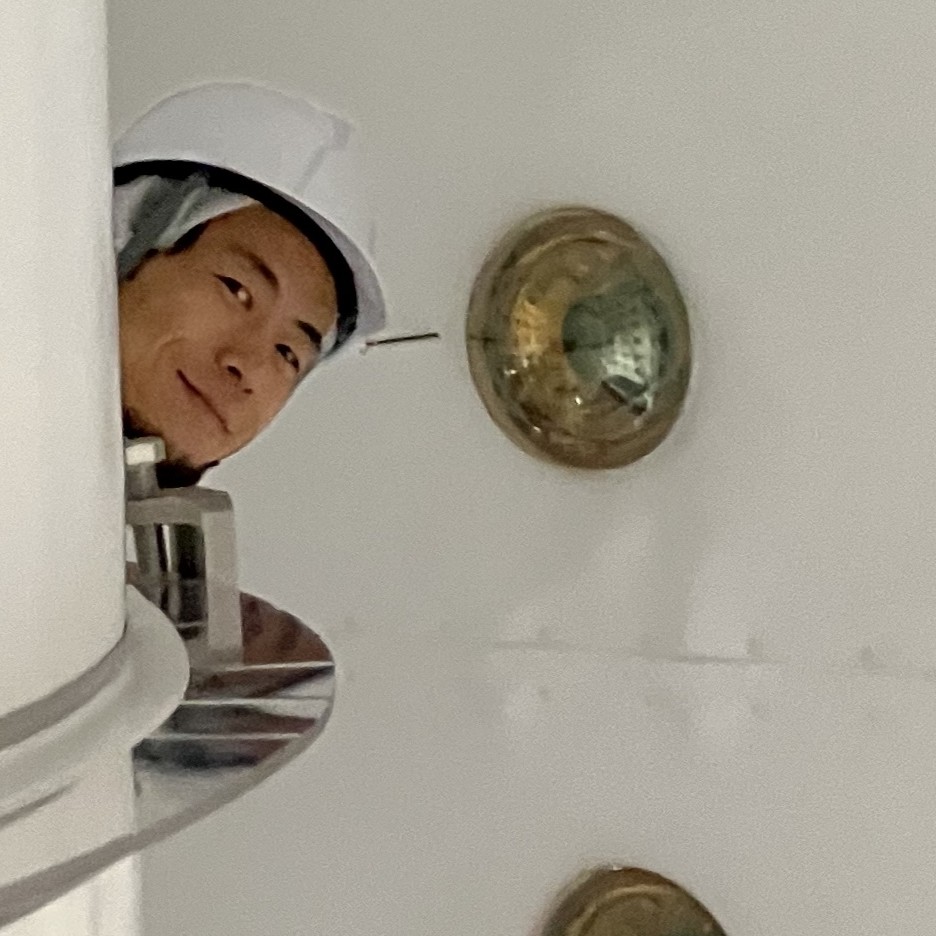
ICRR, The University of Tokyo
Research Topics
Dark Matter direct search
Detector development for underground experiments
Introduction
I am a postdoctoral researcher at ICRR Kamioka for the XENONnT dark matter experiment. My research interest is exploring physics beyond the Standard Model through underground experiments, particularly on detector development and hardware-oriented approaches.
During my PhD at Kyoto University, I was involved in the development of a high-pressure gas xenon time projection chamber (TPC) for the AXEL experiment, which is aimed to search for neutrinoless double beta decay. My focus was the design and operation of a strong and uniform drift electric field inside the TPC. I was struggling to deal with spark discharge, but we eventually achieved stable operation and demonstrated high detector performance like the world-best energy resolution as a xenon detector at that time.
As a postdoc, I changed my field to dark matter search, the XENONnT experiment. XENONnT is also based on a xenon TPC but with liquid-gas dual phase configuration. Though they are both TPCs, the difference of its phase (gas or liquid) makes different detector characteristics such as light and charge yields, event topologies, and self-shielding capabilities. I am really enjoying to learn both the difference and commonalities between them. From now, I will work on establishing new calibration method using a neutron generator and applying the improved calibration result to low-mass WIMP search.
In my free time, I love playing poker and practicing Japanese archery (Kyudo).

IPMU, The University of Tokyo
Research Topics
Astroparticle Physics Neutrino physics
High Energy Astrophysics
Introduction
I am a postdoctoral fellow at IPMU working with the Hyper-K collaboration. Although my current research interests revolve around preparing Hyper-K to find galactic and extragalactic sources of high-energy neutrinos, my path into astrophysics was anything but linear. As an undergraduate at UC Berkeley, I studied starspots with Professor Gibor Basri and participated in the University of Tokyo Research Internship Program (UTRIP) where I researched stellar rotation periods with Professor Yasushi Suto. I then briefly pivoted to biophysics during my master’s degree before finding my way back to astrophysics through my Ph.D. work with Professor Naoko Kurahashi-Neilson and the IceCube Collaboration, where my thesis focused on creating a statistically sound method to combine datasets with unique event topologies and search the entire sky for sources of astrophysical neutrinos.
Outside of neutrinos, I enjoy video games, makeup, learning kanji, and snowboarding!